

The fitness community across the UAE is abuzz with talk of “HYROX training.”
In July 2025, Abu Dhabi brought together 3,506 athletes from across the globe, including 213 professionals, for one of the world’s largest indoor fitness races in the Middle East.
Many see Hyrox as a race, but before that, it is a structured fitness methodology that combines running and functional strength training into a single, balanced system. It develops hybrid fitness, meaning strength and endurance work together rather than compete against each other.
What is HYROX Training and Why Should You Care?
Unlike traditional gym splits or endurance-only routines, HYROX training challenges your body to be strong, stable, and capable over long periods. Even if you never register for a HYROX event, the workouts themselves help you move and feel better. They help you build a body that performs in the gym, on the road, and in daily life.
HYROX training: More Than Just a Competition
Each HYROX event features a fixed sequence of running and movement stations, but training for it is much broader. It includes running, sled pushes, sled pulls, rowing, SkiErg, sandbag lunges, wall balls, farmers carries, and burpees. These exercises demand efficient movement and endurance, but they can benefit anyone, whether competitors or not.
Why HYROX Training Is Gaining Popularity
Not just the fitness community in Dubai, people across the world are embracing HYROX style workouts because they solve common training frustrations.
HYROX training:
- Offers measurable targets
- Keeps training interesting
- Improves both strength and endurance
- Reflects real-life physical challenges
HYROX-style training introduces balance to your fitness plans. It keeps those who get bored with repetitive cardio engaged. It also gives you a reason to care about endurance, especially if you are a strength-focused athlete.
What This Guide Covers
Through this guide, we will explain how to train using the HYROX methodology at every level. After reading, you will learn:
- Training frameworks
- Key movement techniques and progressions
- Weekly training templates
- Optional race preparation strategies
The HYROX Training Philosophy: Building the Complete Hybrid Athlete
The HYROX training philosophy promotes complete fitness instead of isolated skills. It trains you to be a hybrid athlete, not just a gym rat or fitness person focused only on cardio. It’s about bringing balance and harmony to your fitness training.
What Does “Hybrid Athlete” Mean?
A hybrid athlete runs, pushes, pulls, and carries without losing form or stamina. The concept bridges the gap between endurance and strength. Runners gain power, lifters boost their capacity, and everyone develops balanced physical ability.
The Three Pillars of HYROX training
| Pillar | What It Develops | Why It Matters |
| Running Economy | Aerobic base, pacing control | Improves endurance efficiency |
| Functional Strength | Grip endurance, hip, and posterior strength | Powers sleds, carries, and lunges |
| Work Capacity | Ability to sustain multi-phase effort | Keeps output high when tired |
HYROX training is effective because it builds all three together. Training for only one creates limits, but a balanced routine trains both muscle and engine.
Why This Philosophy Works
If you are a beginner, you get a head start on building a complete base, avoiding one-sided development. On the other hand, intermediates can rely on Hydroxy training to address weaknesses, whether it’s running speed, grip strength, or recovery.
Many pros use this to fine-tune the smallest details in performance. The HYROX training methodology is effective because it’s year-round, not just a 12-week blitz. It’s progressive, not a quick fix. And most importantly, it offers a sustainable way to keep going.
The 8 Core HYROX Movements: Technique, Purpose, and Progression

The heart of HYROX training lies in mastering eight core movement patterns. They reveal how efficiently you move and how prepared your body is to handle challenges. While most people push for intensity first, it’s best to nail the basics, or you risk injury and burnout.
Movement 1: SkiErg
The SkiErg is one of the most effective tools in HYROX training for building full-body endurance and control. It teaches coordination, rhythm, and efficient energy use. Each pull mimics cross-country skiing and challenges both strength and conditioning across your core, shoulders, and back.
- Trains: Full-body pull strength and cardiovascular endurance
- Technique: Hinge at the hips, coordinate the arm pull with core snap, maintain rhythm
- Common Mistake: Using arms only and standing tall
- Progression: Start with timed intervals, then move to distance goals, and finally target power output.
Movement 2: Sled Push
The sled push develops drive, lower-body strength, and grit. It trains your body to generate consistent force under fatigue, replicating what athletes experience in HYROX competitions. Proper technique on sled pushes strengthens your hips and legs while building mental resilience.
- Trains: Lower-body drive, hip extension, and grit
- Technique: Stay low, drive short steps, engage core
- Common Mistake: Standing upright or losing traction
- Progression: Begin with low resistance over distance, increase weight over time, then practice competition speed.
Movement 3: Sled Pull
The sled pull strengthens your posterior chain, grip, and coordination. It focuses on controlled, powerful motion, using the back and legs together to generate force. This HYROX element demands grip endurance and total-body stability, making it essential for hybrid performance.
- Trains: Posterior chain, forearms, and upper back
- Technique: Sit back, pull with straight arms, then finish with a strong row
- Common Mistake: Overusing arms only without engaging your hips and core
- Progression: Seated rope pulls → standing pulls → heavy rope climbs.
Movement 4: Burpee Broad Jumps
Burpee broad jumps challenge explosiveness and body control. They mix the conditioning benefit of burpees with the power demand of long jumps. In HYROX training, they teach rhythm, breathing control, and quick recovery between dynamic efforts.
- Trains: Power, coordination, conditioning
- Technique: Controlled descent to the floor, jump forward explosively, and land smoothly.
- Common Mistake: Jumping for height, not distance
- Progression: Step-back burpees → full burpee jumps → continuous flow sets.
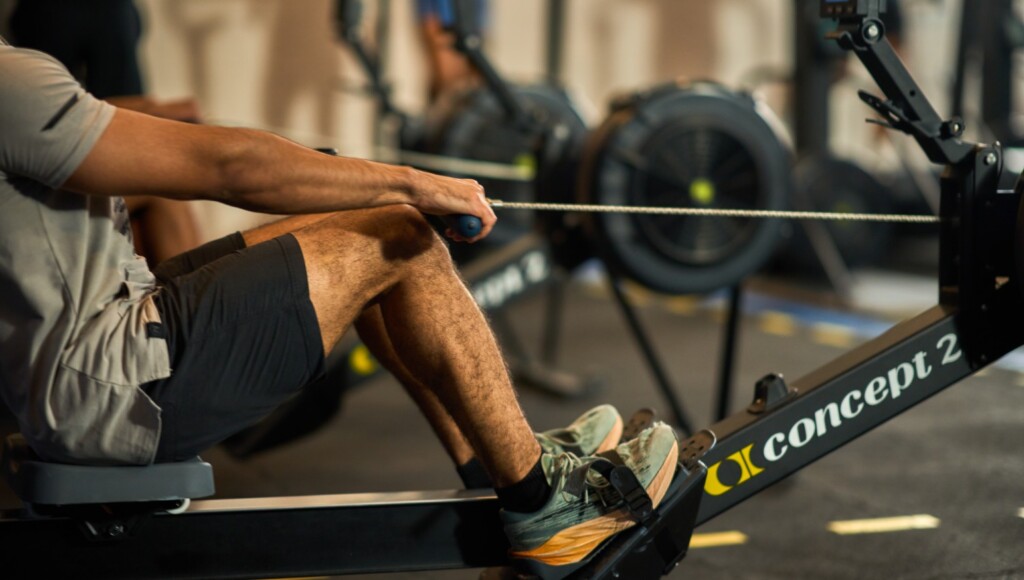
Movement 5: Rowing
Rowing is a cornerstone of HYROX endurance training. It builds aerobic power, rhythm, and full-body synchronization. Each pull integrates legs, back, and arms, helping you maintain steady pacing without wasting energy.
- Trains: Endurance and total-body synchronization
- Technique: Legs drive first, then back, then arms
- Common Mistake: Pulling early with arms or jerking the handle
- Progression: Form drills → steady-state → interval challenges.
Movement 6: Farmers Carry
The farmers carry strengthens grip, core, and postural muscles. In every HYROX race, this station tests more than your strength; it tests composure under load. Maintaining an upright posture under fatigue improves your stability and confidence across all movements.
- Trains: Grip strength, posture, and stability
- Technique: Stand tall, short steps, deep breathing
- Common Mistake: Leaning forward or dropping shoulders
- Progression: Lighter carries for distance → weighted carries → competition loads.
Movement 7: Sandbag Lunges
The sandbag lunge tests unilateral control and balance. It forces the athletes to stabilize under shifting weight while keeping movement smooth and steady. Over time, this exercise helps you build resilient hips and strong legs vital for sustained HYROX performance.
- Trains: Balance, single-leg strength, and core alignment
- Technique: Rest the sandbag on your shoulders, keep your chest open, and step steadily
- Common Mistake: Rushing movement or collapsing forward
- Progression: Bodyweight lunges → light sandbag → heavier sandbag.
Movement 8: Wall Balls
The wall ball combines strength, coordination, and cardiovascular output. It challenges your entire body while developing timing between squat power and throw accuracy. In HYROX training, wall balls test finishing ability after long, intense circuits.
- Trains: Leg power, shoulder endurance, coordination
- Technique: Full squat, drive with hips, catch ball smoothly
- Common Mistake: Shallow squats or throwing with arms only
- Progression: Use light weights initially, then aim for full targets with competition ball.
Coach Insight: “Most athletes look for speed too early. Hyrox performance depends on your technical consistency, not rushing the process. So, perfect your movement first, then add intensity.”
Structuring Your HYROX Training Week: Templates for Every Level
Building a HYROX training plan means finding the right balance between running, strength and conditioning, and downtime. In Dubai, with busy work and family life, training needs flexibility. You should use these templates as guides, not rigid rules.
Planning Your Training Week
Prioritize three areas each week:
- Running days build endurance.
- Strength days sharpen skill and power.
- Mixed days develop work capacity and transitions.
Rest is a training tool. You train better and make faster progress by including recovery days, either as light activity (walking, stretching) or full rest. So, adjust your load based on energy levels or weekly commitments.
Beginner Weekly Template (3–4 Days):
| Day | Focus | Example Session |
| 1 | Running + Core | 20–30 min easy run + core exercises |
| 2 | Functional Strength | Squats, lunges, rows, carries |
| 3 | Recovery | Stretching, foam rolling, light movement |
| 4 | Mixed Conditioning | Simple circuit of Hyrox movements |
If you are a beginner, you should train consistently, learn form, and avoid rushing intensity. The objective is to build an aerobic base and proper movement foundations.
Intermediate Weekly Template (4–5 Days):
| Day | Focus | Example Session |
| 1 | Running Intervals | 400m repeats or tempo runs |
| 2 | Lower Strength | Sleds, lunges, squats |
| 3 | Machines | SkiErg or Row intervals |
| 4 | Upper + Core | Pull-ups, presses, carries |
| 5 | Simulation | Combine 4–5 Hyrox stations + runs |
As an intermediate, you need to manage higher frequency and intensity. That means you should track metrics and focus on HYROX performance improvements week by week.
Advanced Weekly Template (5–6 Days):
| Day | Focus | Example Session |
| 1 | Threshold Running | Race pace or long tempo runs |
| 2 | Heavy Strength | Max load on sleds and carries |
| 3 | Power Intervals | SkiErg and rower work |
| 4 | Active Recovery | Easy movement and mobility |
| 5 | Full Simulation | All 8 stations at race pace |
| 6 | Active Recovery | Light swimming, cycling, or stretching |
If you are an advanced athlete, train with precision. Focus on managing your recovery and energy to keep training without burning out.
HYROX Training for Beginners: Building Your Foundation
HYROX training for beginners is all about habits, not heroics. Dubai’s training culture can feel intense, but consistency and movement skills come first. So, leave comparison aside and focus on your own progress.
Where to Start
Build your base by attending 3–4 sessions per week, split between movement skills and aerobic work. Remember, all levels start with learning. Here’s a priority list for beginners and a few sample workouts.
| Priority | Why It Matters |
| Aerobic Base | Builds the capacity for long sessions |
| Movement Foundations | Prevents injury and sets form early |
| Core Strength | Supports every exercise |
| Grip Strength | Crucial for sled work and carries |
Sample Beginner Workouts
Workout A: Running + Core
- 5 min warm-up walk or jog.
- 20 min easy run.
- 3 rounds: 30 sec plank, 10 dead bugs, 10 bird dogs.
- 5 min cool-down walk.
Workout B: Functional Strength
- 3 rounds: 10 goblet squats, 10 dumbbell rows per arm, 10 walking lunges, 30 sec farmer’s carry.
- Rest 90 sec between rounds.
Workout C: Hyrox Movement Introduction
- 10 min easy row for form.
- 3 rounds: 10 light wall balls, 10 cal SkiErg, 50m sled push (light).
- Rest as needed.
Avoid Common Mistakes Beginners Make
Starting HYROX training can be exciting, but if you are a beginner, avoid making mistakes that slow your progress or lead to frustration. The goal is to build strong foundations before increasing intensity.
So, watch out for these common mistakes:
1. Going all-out too soon
Many new athletes try to match the intensity they see from advanced HYROX competitors. This usually leads to exhaustion and loss of motivation. Fitness develops through patience, not speed. Start with a manageable pace and load. Allow your body to adapt gradually to higher intensity and volume.
2. Neglecting aerobic development
Aerobic endurance is the engine that drives your HYROX performance. But many beginners underestimate its importance, choosing fast, high-intensity sessions over steady, moderate work. You should focus on consistent aerobic runs, rows, or SkiErg sessions to train your heart and lungs to sustain effort over time.
3. Overtraining without recovery
Training more does not always mean you are getting fitter. Without recovery, your body cannot repair or grow stronger. Skipping rest days or training through fatigue increases the risk of injury and leads to burnout. Be sure to schedule recovery days intentionally and treat them as part of your HYROX training program.
4. Focusing on competition instead of competence
Many people focus on racing before learning movement quality. However, poor form under fatigue quickly exposes your weak links. In the early stages, you should prioritize mastering technique and building stability. Competence builds confidence, and confidence drives better long-term performance.
HYROX training for Intermediates: Building Performance and Eliminating Weaknesses

Once you have six months of steady training, your goals and needs change. You can run a 5K without drama. Also, your HYROX movements feel natural, even if not yet fast. The most important thing now is to identify your weaknesses and push your boundaries without overreaching.
Here is a simple way to identify your weaknesses:
- Weak running base → add intervals or tempo work
- Lack of strength → increase load on sleds and carries
- Poor grip → include hangs, holds, and thicker handles
- Fatigue early → train aerobic pacing and threshold
How Intermediates Improve
As you move from learning to refining, your HYROX training plan gets more focused:
| From (Beginner) | To (Intermediate) |
| Learning movements | Refining efficiency |
| Building base fitness | Increasing work capacity |
| Showing up consistently | Training with intention |
| General conditioning | Targeted weakness work |
To make this transition successfully, you must:
- Keep logs of run times, rep counts, and weights to track your performance.
- Start doing more circuit or complex sessions.
- Push faster intervals, heavier loads in pieces to boost intensity.
Sample Intermediate Workouts
Workout A: Running Intervals
- 10 min warm-up jog.
- 6 x 400m at a strong pace, 90 seconds rest.
- 10 min cool-down.
Workout B: Strength Emphasis
- 4 rounds: 50m sled push (moderate), 50m sled pull, 100m farmers carry, 20 sandbag lunges.
- Rest 2 min between rounds.
Workout C: Mixed Conditioning
- 5 rounds for time: 250m row, 15 wall balls, 200m run.
Track Your Progress
Log your key benchmarks:
- 5K run time
- 1000-meter row or SkiErg
- Unbroken wall ball set count
- Maximum sled load for 50m
This tracking connects training with measurable progress, making sure every week helps you build toward efficiency.
HYROX training for Advanced Athletes and Pros: Optimization and Mastery
Once you move to the advanced stage, your focus should be on refinement and mastery. Reaching this point in your training means you have got the fundamentals all figured out. That’s why advanced HYROX training is about the details, like consistency, mastery of movement under fatigue, and smart recovery.
What Sets Advanced Athletes Apart
The biggest difference between beginners and pros is that the latter train with intent, not impulse. In other words, your execution must stay consistent even under fatigue. You also need to learn to balance heavy loads and long runs while protecting recovery.
Core Principles You Should Use
| Principle | Application |
| Specificity | Train movements as in competition |
| Intensity Management | Cycle hard and easy periods |
| Transition Efficiency | Move seamlessly between running and exercises |
| Mental Conditioning | Practice discomfort tolerance |
Advanced HYROX Training Techniques:
- Periodization: Structure your HYROX training into 3–4 week blocks, alternating between strength, endurance, and recovery. This approach helps you peak at the right time and prevents burnout or overtraining.
- Simulations: Regularly perform full HYROX test runs to practice race-day switches and pacing. These simulations let you identify where you can save time and get used to the event’s demands.
- Race-Specific Pacing: Train to master negative splits and maintain your speed even when fatigued. By practicing pacing strategies, you learn to finish strong and handle exhaustion during competition.
- Focus on Weak Links: Prioritize improving your weakest movements, not just your favorites. Tackling your limitations helps you become a more well-rounded and competitive athlete.
Sample Advanced Workouts
Workout A: Threshold Run + Strength
- 4 x 1 mile at 85% effort (2 min rest between)
- Immediately into: 3 rounds of 50m sled push, 50m sled pull, 200m farmers carry
Workout B: Full Simulation (Scaled)
- All 8 Hyrox stations at 80% race weight/intensity
- 500m runs between stations (instead of 1K)
- Track total time
Workout C: Power and Speed
- 10 x 100m SkiErg sprints (45 sec rest)
- 5 x 20 wall balls (unbroken, 60 sec rest)
- 4 x 50m sled push (heavy, 90 sec rest)
Avoid Overtraining
If you notice ongoing fatigue, mood swings, trouble sleeping, or a drop in your performance, it’s a sign you need to ease up. Schedule a lighter HYROX training week every 4–6 weeks to give your body a break.
Prioritize good sleep, proper nutrition, and recovery during these periods. Remember, you can’t reach your best if you skip recovery. Your progress depends on it.
Coach Insight: “You don’t have to be the hardest worker every single day to succeed; you need to be the smartest. At Gravity, we will help you develop consistent, sustainable effort so your progress lasts.”
Nutrition Principles for HYROX training
Hyrox training takes a lot out of you. If your nutrition isn’t on point, you will see slower progress and put yourself at risk. With Dubai’s fast pace and hot climate, you need to pay extra attention to your food and hydration.
Basic Nutrition Guidelines
- Carbohydrates: These are your main energy source for endurance and high-intensity sessions. Choose rice, potatoes, fruit, or oats.
- Protein: You need protein to rebuild your muscles after tough workouts. Go for eggs, chicken, lean beef, or beans.
- Fats: Olive oil, nuts, and fish help you recover and keep your hormones balanced.
Daily Nutrition Breakdown
- Eat 3–4 balanced meals each day with carbs, protein, and vegetables.
- Add snacks if you feel hungrier because of your training.
- Drink water regularly, and during long sessions, use an electrolyte mix if needed.
| Nutrient | Amount | Purpose |
| Protein | 1.6–2.2g/kg bodyweight | Muscle repair |
| Carbs | 3–6g/kg | Energy for endurance |
| Fats | 0.8–1.2g/kg | Hormone stability |
| Water | 3–4L daily (more in Dubai heat) | Recovery and hydration |
Plan Your Pre and Post Workout Nutrition
- Pre-Workout: About 60–90 minutes before training, have carbs with moderate protein (like a banana with peanut butter or toast with eggs).
- Post-Workout: Refuel with protein and carbs to speed up your recovery (try grilled chicken with rice or a protein shake with fruit).
What to Avoid
Don’t push yourself through hard sessions if you haven’t eaten or hydrated. If you are training a lot, avoid cutting your carbs too low. Don’t rely only on shakes or bars; give your body real food.
Adjust your portions based on your body size, HYROX training level, and results. And if you have special routines for Ramadan or other reasons, make sure to adapt your nutrition accordingly.
Recovery and Injury Prevention in HYROX training

Recovery is part of your training. If you ignore it, you risk hitting a plateau or getting injured. With Dubai’s heat and the intensity of your workouts, you need to learn how to recover from HYROX training.
Core Recovery Practices
- Sleep: Getting 7–9 hours of deep, consistent sleep is your most powerful performance tool.
- Mobility: Spend ten minutes after training stretching or foam rolling. You can also visit Dubai’s local specialists for sports massage or physical therapy.
- Active Recovery: Include light walks, cycling, or mobility sessions. Just make sure you keep the intensity low.
Here is a quick roundup of these HYROX recovery tips:
Key Recovery Practices
| Practice | Frequency | Benefit |
| Sleep | 7–9 hours daily | Repairs tissue and hormones |
| Mobility | Daily | Prevents stiffness and injury |
| Active Recovery | 1–2 sessions/week | Improves circulation |
| Rest Days | Weekly | Allows nervous system reset |
Steer Clear of Common HYROX Injuries
- Lower Back: Always brace your core and use a proper hip hinge when mounting the sled.
- Knees: Make sure your squats and lunges are aligned, and never skip your warm-up.
- Shoulders: Don’t overdo wall balls or overhead presses; keep your training balanced with pulling movements.
- Grip/Forearms: Increase your grip load gradually, and regularly massage your hands and forearms.
If you notice any pain or swelling, reach out for professional help right away. Your form and mechanics should always come first, and Gravity’s coaching team is here to support you with its expertise in calisthenics and movement.
Taking It to the Race
Curious about competing? You don’t have to, but if you are training for your first HYROX race, you must plan everything. Most Dubai Hyrox athletes come from running, CrossFit, or functional fitness backgrounds and thrive with structured lead-up plans. That’s what will also help you prepare, but first, you need to know if you are ready for a HYROX race.
Are You HYROX Race Ready?
Before you step up to the starting line, make sure you’ve laid the groundwork for a successful race. Being fully prepared will help you perform at your best and enjoy the whole experience.
You might be ready for your first HYROX race if you:
- Can run 8–10 km without taking breaks.
- Can perform all 8 Hyrox movements even when you are a bit fatigued.
- Have completed at least two full or partial race simulations.
- Feel mentally excited and ready for a demanding race day.
Your Race Preparation Checklist (4–6 Weeks Out)
As your competition approaches, focus on the final details that will set you up for a strong performance. Follow this checklist to build confidence and set yourself up for success on race day.
- Simulations: Every two weeks, you should complete a full or partial HYROX simulation. This helps you get comfortable with transitions, test your fueling strategy, and sharpen your mental focus so you know exactly what to expect.
- Race-Pacing: You need to practice keeping a steady pace throughout each section instead of going all out from the start. This teaches your body to sustain effort and avoid burning out before the finish.
- Nutrition and Hydration: Make sure you dial in your pre-race meals and hydration plan well before race day. Practicing this in advance keeps your body fueled and ready, eliminating any last-minute surprises.
- Taper: In the last seven to ten days, reduce your training volume. Focus on moving well, minimizing soreness, and preparing your mind so you feel fresh and confident when you toe the line.
Competing is just one way to challenge yourself. What matters most is the progress you make through your daily HYROX training, whether or not you choose to race.
Why Gravity DXB is the Ideal Training Ground for Hyrox Athletes in Dubai
Since 2015, Gravity DXB has set the benchmark in functional training for locals. Our sprawling facility offers everything needed for authentic HYROX training in Dubai, including sleds, rowers, SkiErgs, wall balls, sandbags, and an open training space under expert coaching supervision.
Our coaches specialize in hybrid fitness training, bridging calisthenics, strength, and conditioning into a community-driven environment. Joining our Hyrox classes means signing up for accountability and getting access to people following the same path to hybrid fitness.
If you are ready, start with a consultation or drop-in for a trial session. Speak with one of our coaches to plan your HYROX training based on your goals and fitness level.
Start Your HYROX Training Journey Here Today

HYROX training builds complete, functional fitness that lasts. It balances running, lifting, and endurance for strength that carries into life. Wherever you start, the path is clear: master movement, train consistently, recover smartly, and progress one week at a time.
You don’t need a race to experience the impact of HYROX training. But if you do race, you will be ready.
Start your HYROX training journey today with Gravity DXB, where passion meets performance, and every athlete builds strength that lasts. Contact us now to get started.
Frequently Asked Questions (FAQ)
Q1: What is HYROX training?
HYROX training is a fitness methodology that combines running with functional strength exercises like sled pushes, rowing, wall balls, and farmer’s carries. It builds hybrid fitness, improving both endurance and strength.
Q2: Do I need to compete in a race to benefit from HYROX training?
No, HYROX training is an effective fitness approach for building well-rounded strength and endurance, whether or not you plan to race.
Q3: How many days a week should I train for HYROX?
If you are a beginner, aim for 3–4 training days each week. As you gain experience, increase to 4–5 days. Advanced athletes should train 5–6 days weekly, always including planned recovery.
Q4: What equipment do I need for HYROX training?
You will benefit from access to a sled, rower, SkiErg, sandbag, wall balls, and kettlebells or dumbbells for carries. At a functional fitness gym like Gravity DXB, you get all the equipment you need.
Q5: How long does it take to get ready for a HYROX race?
It depends on your current fitness level. If you are just starting, plan for 12–16 weeks of consistent training. If you are more experienced, you might be ready in 8–10 weeks.
Q6: Is HYROX training good for weight loss?
Yes, you can lose weight with HYROX training. The combination of running and functional strength work helps you burn calories and build muscle, supporting long-term fat loss.
Q7: Can I do HYROX training if I’m not a good runner?
Yes, you don’t have to be a strong runner to start. As you continue your Hyrox sessions, you will naturally improve your running ability over time.
Q8: What’s the difference between HYROX and CrossFit?
Hyrox has you perform a set group of 8 movements and running in a predictable sequence. CrossFit, on the other hand, involves a wider range of movements, more Olympic lifting, and constantly changing workouts.
Key Takeaways
If you are considering HYROX training, you will benefit from a balanced approach that builds both strength and endurance. Here are the main points you should keep in mind as you get started:
- With HYROX training, you develop hybrid fitness by combining strength and endurance in your workouts.
- You base your progress on mastering the 8 key movements that make up the core of Hyrox events.
- Your weekly schedule should include 3–4 training days if you are a beginner, 4–5 if you are intermediate, and 5–6 if you are advanced.
- Focus on performing exercises with proper form and allowing time for recovery before you emphasize speed.
Remember, competing is optional. Your fitness gains from HYROX training will benefit you regardless of whether you enter a race.