
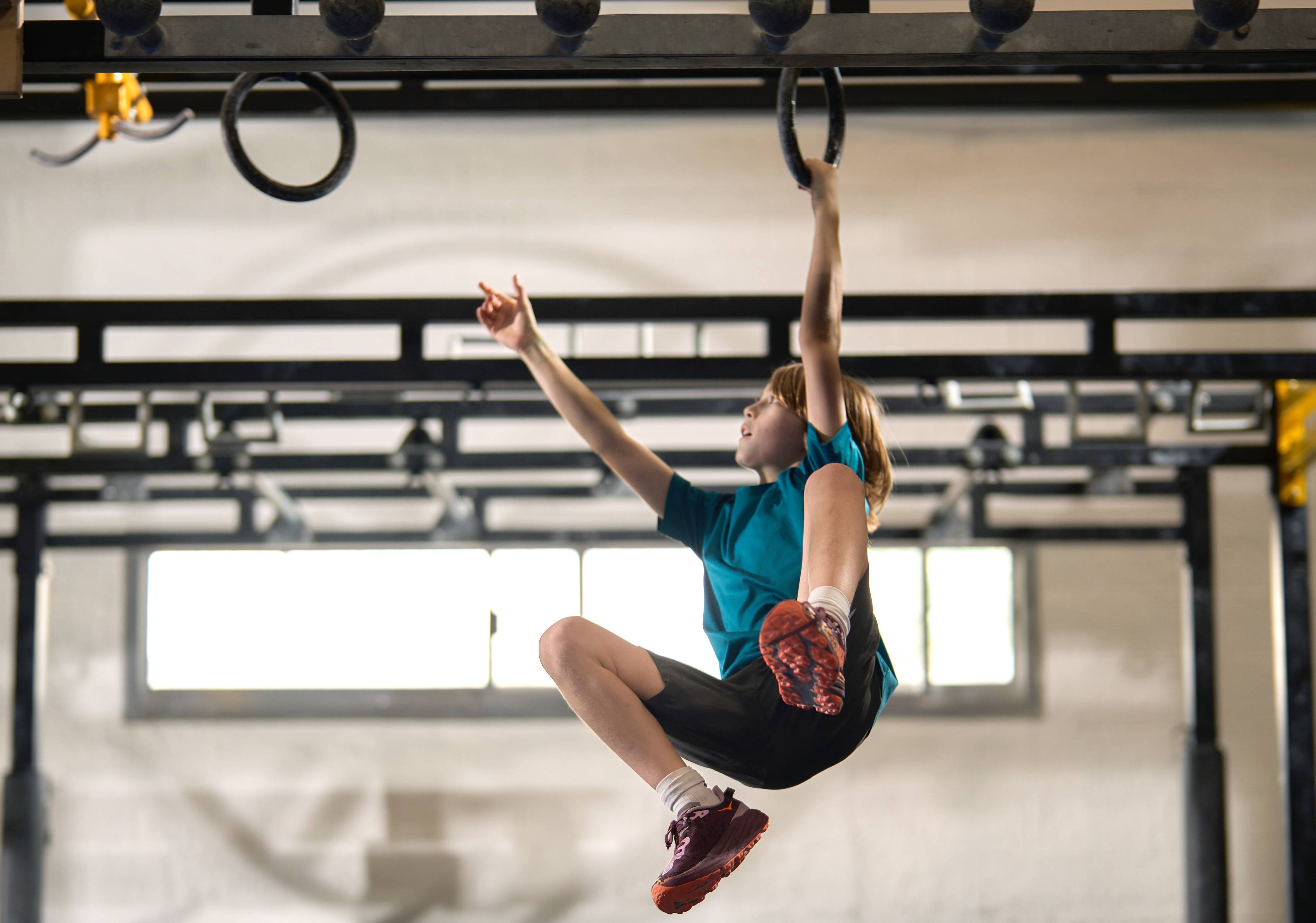
After years of coaching on the gym floor, we’ve seen the same patterns come up again and again. Athletes eager to progress, working hard, and yet stalling, getting injured, or plateauing far earlier than they should. The reason is almost never a lack of effort. It’s almost always a handful of fixable training mistakes that compound quietly over time.
Whether you’re building your first pull-up, working toward a muscle-up, or developing the spatial awareness needed for parkour vaults, the principles that separate steady progress from frustrating setbacks are surprisingly consistent. Here’s what we see most often, and what you can do about it.
The Biggest Calisthenics Errors That Hold Athletes Back
Skipping the Foundations
This is the single most common mistake we see with new calisthenics athletes. Everyone wants the front lever or the human flag. Nobody wants to spend three weeks on hollow body holds and scapular pulls. But those fundamentals aren’t filler work. They’re the actual architecture that every advanced skill is built on.
When athletes skip progression-based groundwork, they compensate. The wrong muscles take over. Joints absorb load they’re not designed to handle. And the movement pattern gets wired in incorrectly from the start, which is far harder to unlearn than it would have been to learn correctly the first time.
Take a step back before you push forward. Mastery of basics creates the conditions for advanced skills to emerge naturally rather than being forced.
Neglecting Scapular Stability and Shoulder Health
Calisthenics places enormous demand on the shoulder girdle. Pulling movements, pushing movements, support holds. The shoulder is involved in almost everything, and poor scapular control is one of the leading form mistakes we correct across all experience levels.
Signs of this problem include shrugged shoulders during pull-ups, winging scapulae in push-ups, and instability at the top of a dip. Left unaddressed, these patterns don’t just limit performance. They create chronic discomfort and, in more serious cases, injury that can sideline training for months. Research on resistance training adaptations consistently points to the importance of controlled loading and joint stability in preventing soft tissue injury during bodyweight progressions.
Chasing Repetitions Over Quality
High rep counts feel productive. They’re not always useful. Ten controlled, full-range pull-ups with proper hollow body tension, depressed scapulae, and a clean lockout build far more usable strength than thirty half-reps performed with momentum and a kipping swing.
We tell our members this often: if the form breaks, the set is done. Not because we’re strict for the sake of it, but because every rep with compromised mechanics is a rep that reinforces a pattern you’ll eventually need to undo.
Commit to the Coolest Version of Yourself.
Parkour Training Mistakes That Create Real Risk
Progressing Too Fast, Too Soon
Parkour has a unique challenge that sets it apart from gym-based training. The consequences of mistakes aren’t just missed reps. They can involve falls, impacts, and contact with hard surfaces. This is why parkour training mistakes related to progression are particularly worth taking seriously.
We see athletes attempting precision jumps, cat leaps, or drops at distances well beyond what their current level of body control justifies. The thinking is usually “I’ve done something similar before” rather than a genuine assessment of whether this specific movement, on this specific surface, at this specific distance, is within their demonstrated capability.
Structured competition preparation and movement development should always follow a deliberate progression ladder, building confidence and competence in equal measure.

Ignoring Landing Mechanics
Landings are where injury happens in parkour. Poor landing mechanics, primarily a failure to load through the full kinetic chain (ankle, knee, hip absorbing force in sequence) place excessive stress on the joints and dramatically increase the risk of acute injury.
The fix is drilling landings at low height first. Not because low drops are exciting, but because the pattern needs to become automatic before the stakes are raised. Functional fitness principles are clear on this: movement competency must precede movement intensity.
Training Without Adequate Warm-Up
Cold muscles and cold connective tissue do not move well. A rushed or skipped warm-up is one of the most consistent contributors to both minor and significant injuries in parkour training. This isn’t about going through the motions of a few arm circles. It’s about genuinely elevating core temperature, priming the nervous system, and moving through the specific ranges of motion you’re about to demand from your body.
At Gravity Calisthenics Gym, every session begins with structured movement prep, because we know from experience that this single habit changes injury outcomes significantly.
Training Smarter: What Good Practice Actually Looks Like
The Role of Structured Programming
One of the clearest distinctions between athletes who progress steadily and those who stagnate is the presence of a plan. Random training, even high-effort random training, produces inconsistent results. Structured, progression-based programming accounts for volume, intensity, recovery, and skill development in a way that adds up over time.
Here’s a simplified comparison of reactive versus structured approaches to training:
| Approach | Reactive Training | Structured Training |
|---|---|---|
| Programming | Train what feels good that day | Planned progressions with clear targets |
| Recovery | Overlooked or inconsistent | Built into the weekly schedule |
| Skill Work | Attempted without prerequisite strength | Introduced after foundational capacity is confirmed |
| Injury Risk | Higher due to overreach and imbalance | Reduced through progressive loading |
| Progress Rate | Fast initially, then plateaus | Slower start, consistently compounding |
A Note on Counterarguments
Some athletes push back on structured progression, arguing that free exploration is how parkour and calisthenics are meant to be practiced. There’s real truth in this. Creativity and freedom of movement are part of what makes these disciplines compelling, and rigid programming can sometimes kill that spirit.
The balance we’ve found is to build a strong foundation through structured practice, then allow creativity to operate within a body that’s actually capable of expressing it safely. Freedom of movement becomes more meaningful, not less, when you have genuine control over your body. The global fitness industry has seen a sustained shift toward functional and bodyweight training because athletes are realizing that capability, not just appearance, is the real goal.
Looking Ahead: Where These Disciplines Are Going
We’re already seeing the next wave of calisthenics and parkour training emphasize data-informed recovery, personalised skill progressions, and greater integration between movement disciplines. Athletes who train at the intersection of strength, coordination, and mobility will be the ones best equipped for what competitive functional fitness looks like over the next decade. Avoiding the common training mistakes outlined here isn’t just about staying injury-free now. It’s about building a body and a movement practice that stays capable for the long term.
If you want to start or reset your training with that kind of intention, booking a class at Gravity is a straightforward first step. We’ll meet you where you are and build from there.
The athletes who progress most consistently are not always the most talented. They’re the ones who take the fundamentals seriously, check their ego at the door, and trust the process. That’s what we’re here to support.
- Always prioritize movement quality over volume or complexity
- Treat warm-up as training, not a formality
- Build scapular strength and landing mechanics before advancing skills
- Follow a progression plan, even a simple one
- Get feedback from a coach before bad habits become deeply ingrained
Consistency beats intensity every time. Build well, and the results take care of themselves.
If you’ve been making some of these mistakes, don’t worry. Recognizing them is already most of the work. For more on how to approach fitness competition preparation and structured training, we’ve covered that ground too.
Still Thinking About It? Just Book It.
Frequently Asked Questions
How long does it take to fix bad form habits in calisthenics?
Most athletes see meaningful form improvement within 4 to 6 weeks of focused correction, provided they practice consistently and get regular coach feedback. The key is reducing training volume temporarily so quality can be prioritized over quantity while the new pattern gets established.
Can complete beginners train parkour safely, or is it only for experienced athletes?
Complete beginners can train parkour safely from day one when introduced through a structured class environment. At Gravity, we start new participants with ground movement, balance work, and low-height precision landings before anything involving elevation or distance, making the discipline genuinely accessible.
Is training calisthenics and parkour together in the same program a good idea?
Yes, combining both disciplines is highly effective because they complement each other directly. Calisthenics builds the upper body and core strength that parkour demands, while parkour develops spatial awareness and reactive coordination that pure calisthenics training rarely challenges. Most of our members train both within the same weekly schedule.