
HYROX is recognized as the world’s largest indoor fitness competition, combining endurance, strength, and functional movement into a single high-intensity race. Unlike traditional runs or gym sessions, your success depends not just on speed but on how efficiently you navigate each of the HYROX workout stations.
Globally, HYROX has grown rapidly, with 80+ global races held in 2025, which saw over 550,000 athletes. Dubai’s HYROX community is no exception. Enthusiasts from all backgrounds are drawn to the challenge, eager to measure strength, endurance, and technique against like-minded athletes.
The standard HYROX competition challenges you with 8 x 1km runs interspersed with 8 functional workout stations, testing every aspect of your fitness. While many athletes focus heavily on running, the reality is that most time is lost at stations. Mastering these stations is what separates finishers from top competitors.
We’ve already discussed HYROX training at length. This guide provides a detailed, station-by-station breakdown, giving you actionable strategies, weekly training protocols, and tips to refine your technique.
HYROX Race Format: Understanding the Full Picture Before You Train
The typical HYROX race format combines 8km of running with 8 functional workout stations, alternating in a run → station → run → station pattern. Your success depends on endurance, strength, and efficient transitions between movements.
Knowing the HYROX workout order is key since each station targets different muscles and energy systems. Fatigue at one station can affect your performance in the next, so the pacing strategy is also equally critical. Time benchmarks help you track progress. Generally, beginners finish over 90 minutes, intermediates between 70 and 90 minutes, and elite athletes take under 70 minutes.
Moreover, open, Pro, and Doubles categories have weight-specific standards. Men and Pro athletes face heavier sleds, kettlebells, and medicine balls, while women and doubles teams follow adjusted loads.
You can better plan your energy use if you know the full HYROX race layout. Pacing wisely and focusing on smooth transitions can help you maintain consistency across all HYROX stations and finish strong. That should be the foundation of your HYROX training.
STATION 1: SkiErg (1,000m)
The SkiErg is your first functional challenge after the opening 1km run. Completing 1,000 meters on the Concept2 SkiErg tests your upper body endurance and cardiovascular capacity.
This vertical pulling movement simulates Nordic skiing. As the opening station, your performance sets the tone for the entire HYROX race. You need a sustainable pace. If you start too fast, you can burn out your arms and lungs before the halfway mark.
Muscles Targeted
- Latissimus dorsi: Drives the handles downward.
- Triceps: Extends the arms at the bottom of each pull.
- Core and abdominals: Stabilize your torso and transfer power.
- Shoulders and upper back: Support overhead positioning and control return.
The Movement
- Start with arms overhead, pulling handles in a smooth arc.
- Hinge at the hips, driving arms past your thighs.
- Maintain straight arms throughout.
- Return handles in a controlled motion.
- Sync breathing with each stroke.
The Challenge
After the first 1km run, your heart rate is elevated, making it tempting to sprint. Many athletes start too fast, leading to arm and lung fatigue before 500m. Grip demands here also affect later stations like the sled pull and farmer’s carry. Efficiency and pacing from the very first stroke are essential to preserve energy for the remaining HYROX stations.
Strategy
- Pace yourself in the first 300m.
- Focus on hip drive over arm strength.
- Maintain a consistent stroke rate.
- Gradually increase effort in the final 200m.
- Train SkiErg immediately after running for race simulation.
Weekly Training Protocol
- 2x per week: 1,000m time trials.
- Interval work: 5 x 200m, 45-second rest.
- Combo sessions: 1km run + 1,000m SkiErg.
Coach Insight: The SkiErg is where we see many first-timers burn out. Your goal is to finish Station 1 with energy left for the remaining HYROX stations. That’s what you must focus on.
STATION 2: Sled Push (50m)
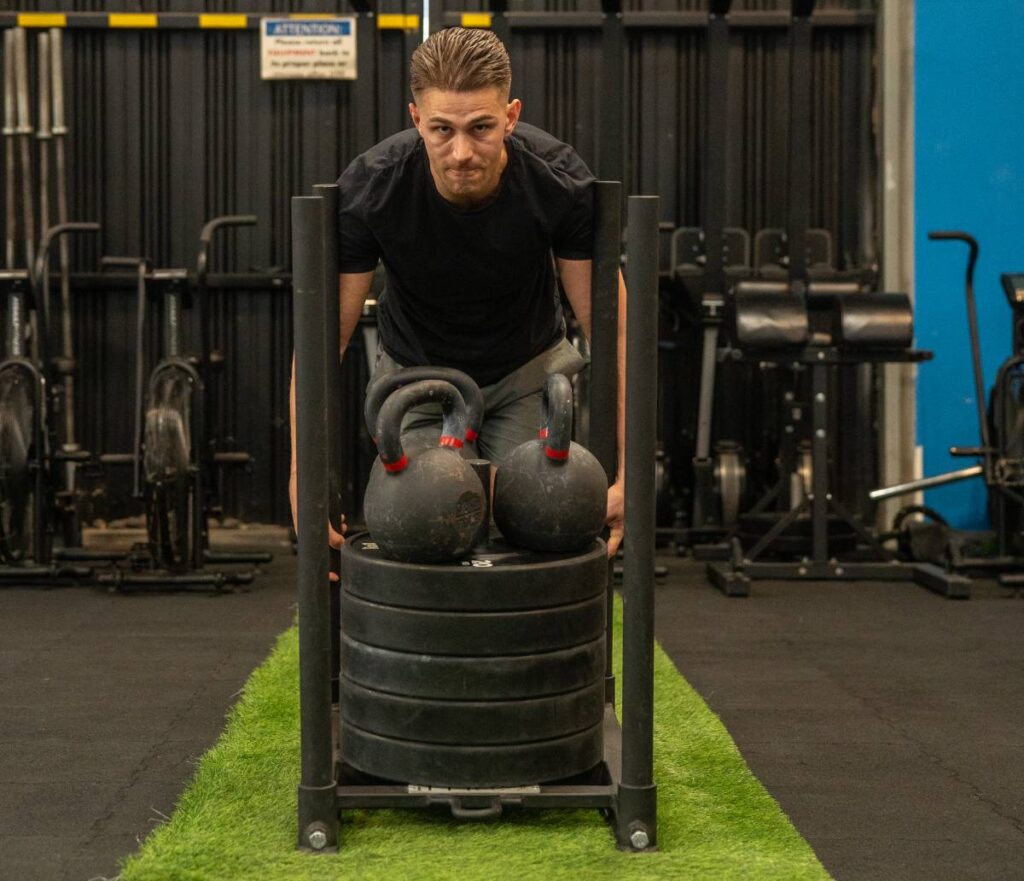
The sled push workout is a 50-meter test of raw lower body strength and power, requiring you to drive a heavily loaded sled across the competition floor. In the Open category, men push 152kg while women push 102kg.
Pro athletes face even heavier loads at 202kg for men and 152kg for women. This HYROX station rewards strong lower-body training and punishes anyone who has neglected leg strength in favor of cardio.
Muscles Targeted
- Quadriceps: Primary driving force behind each powerful step.
- Glutes: Generate hip extension to keep the sled moving.
- Calves: Provide the final push and maintain ankle stability.
- Core stabilizers: Keep the body rigid and transfer force efficiently.
- Shoulders: Hold an isometric position against the sled handles.
The Movement
- Grip sled handles at a comfortable height.
- Keep your body at a 45-degree angle (chest over hands).
- Drive through your legs with short, powerful steps.
- Keep your head neutral, eyes looking at the ground ahead.
- Maintain constant forward momentum.
The Challenge
After 2km of running and 1,000m on the SkiErg, your legs are already fatigued. Getting the sled moving from a standstill is often harder than maintaining momentum. Stopping mid-push requires significantly more effort to restart, making leg strength, grip, and mental determination crucial to finishing efficiently.
Strategy
- Get low and stay low throughout the push.
- Short, choppy steps beat long strides.
- Don’t stop moving; regaining momentum is harder than maintaining it.
- Breathe rhythmically with your steps.
- Train with heavier weights than competition standards.
Weekly Training Protocol
- Sled push variations: 4 x 50m at race weight.
- No sled? Use leg press, wall sits, and heavy goblet squats.
- Combo workout: 1km run + sled push simulation.
Coach Insight: The sled push is where strong legs and strategic pacing separate competitors. Focus on consistency and rhythm to maintain power across this HYROX station.
STATION 3: Sled Pull (50m)

The sled pull requires you to move the same weighted sled 50 meters while facing it and pulling with a thick rope using a hand-over-hand motion. Weights are identical to the sled push (152kg for men, 102kg for women in Open). However, the mechanics demand grip endurance, back strength, and efficient rope management, making this an often underrated HYROX station.
Muscles Targeted
- Back (lats, rhomboids, traps): Generate pulling force with each hand switch.
- Biceps: Assist back muscles and control the rope.
- Forearms and grip: Maintain hold through repetitive pulls.
- Core: Stabilizes your torso and prevents forward collapse.
- Legs: Anchor your body for a strong, stable base.
The Movement
- Face the sled and grab the rope with both hands.
- Sit back into your heels for leverage.
- Pull hand-over-hand in a steady rhythm.
- Keep the rope moving smoothly without piling.
- Maintain a strong, stable base throughout.
The Challenge
Your grip has already worked hard from SkiErg pulls, and your forearms face repeated high-intensity contractions during this HYROX station. Fatigue leads to “forearm pump,” while tangled rope or poor rhythm can waste energy and slow your pace.
Strategy
- Establish a rhythm early and stick to it.
- Use bodyweight by sitting back into your heels.
- Apply just enough pressure to avoid a death grip.
- Keep the rope organized to prevent tangles.
- Train grip 2–3 times per week.
Weekly Training Protocol
- Rope climbs, or rope pulls: 4 x 15m
- Seated cable rows: 4 x 15 reps, controlled
- Farmer carries for grip: 3 x 100m with a heavy load
- Dead hangs: 3 x max hold
Coach Insight: The sled pull tests grip, back, and mental focus. Consistent technique and rhythm make this HYROX station manageable under fatigue.
STATION 4: Burpee Broad Jumps (80m)
Often considered the most brutal HYROX station, the burpee broad jump challenges your mind and body over 80 meters. Each rep begins with a full burpee, chest touching the ground, followed immediately by an explosive forward broad jump.
Because this HYROX station is distance-based, the length of your jumps determines how many reps you complete. Most athletes perform between 35 and 50 reps, depending on jump distance and fatigue.
Muscles Targeted
- Quadriceps, glutes, and hamstrings: Power the broad jump and absorb landing impact.
- Chest and shoulders: Support bodyweight during burpee push-ups.
- Core: Stabilizes the body during rapid ground-to-jump transitions.
- Cardiovascular system: Faces extreme demand as heart rate spikes.
The Movement
- Drop to the ground with your chest making contact.
- Push up and bring your feet under your body.
- Explode into a broad jump forward.
- Land softly and reset for the next rep.
- Focus on jump distance over speed.
The Challenge
This HYROX station tests your mental and physical resilience. The combination of burpees and jumps places massive demands on your muscles and heart rate. At 80 meters, the distance feels endless, and fatigue can reduce your jump quality as the station progresses, making pacing and focus critical.
Strategy
- Break the 80m into smaller mental chunks (4 x 20m or 8 x 10m).
- Prioritize jump distance over burpee speed.
- Maintain a sustainable breathing rhythm.
- Avoid fixating on the remaining distance.
- Count jumps to track progress.
- Accept discomfort and keep moving.
Weekly Training Protocol
- Burpee EMOMs: 10 minutes, 5 jumps per minute.
- Broad jump practice: 4 x 20m, focusing on distance.
- Combo workout: 1km run + 40m burpee broad jumps + 1km run.
- Mental conditioning: Full 80m simulation once per week.
Coach Insight: This HYROX station breaks many competitors mentally before it breaks them physically. Train your mind to embrace the discomfort. At Gravity, we build this resilience through progressive conditioning that mimics race-day fatigue. If you can conquer Station 4 in training, race day becomes manageable.
STATION 5: Rowing (1,000m)
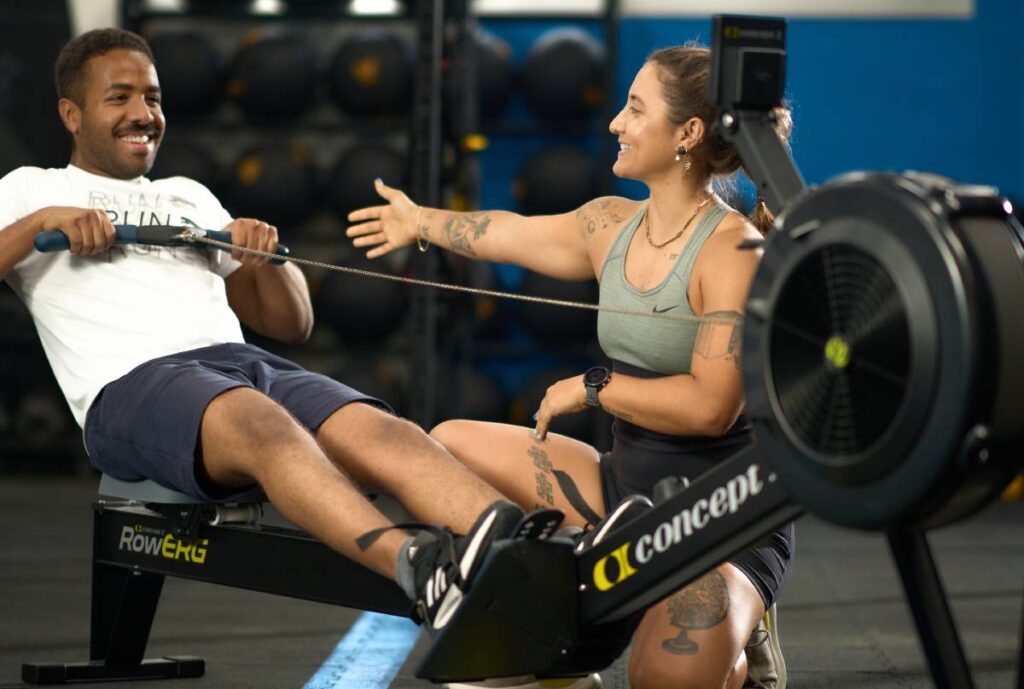
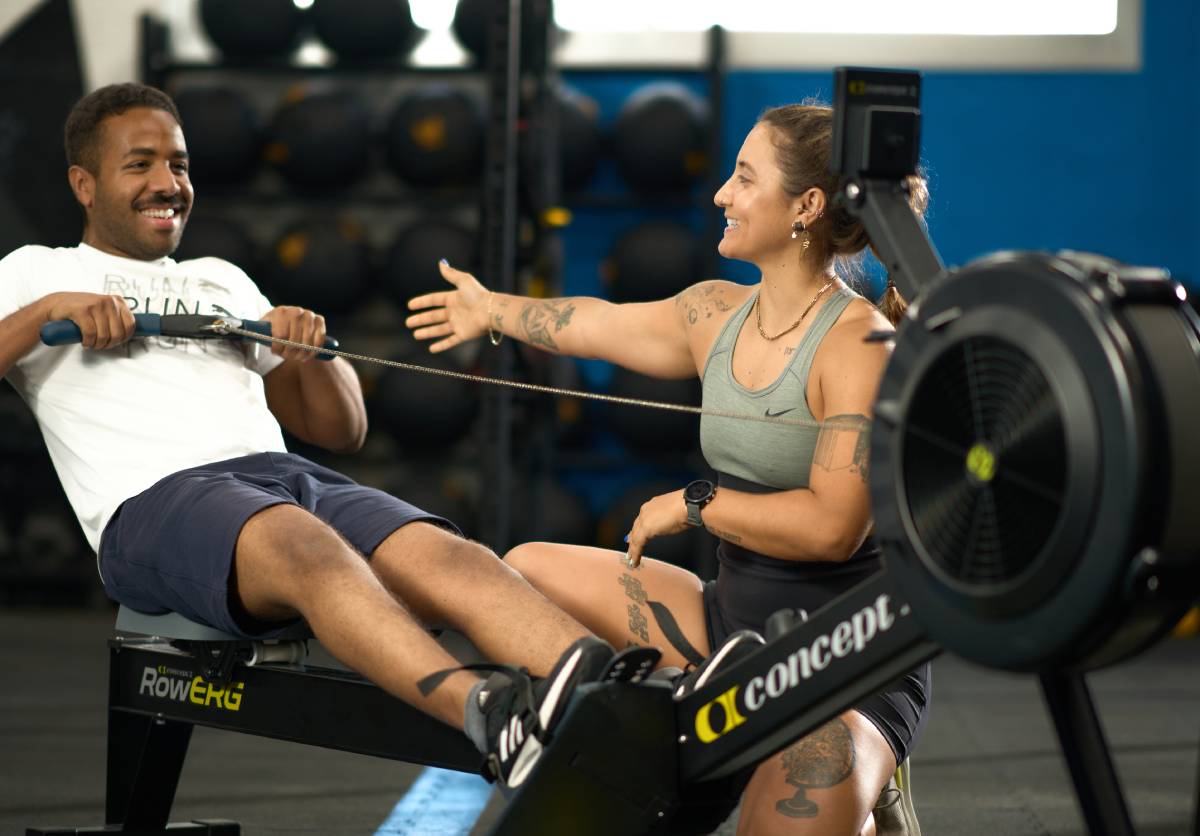
Positioned at the halfway point of your HYROX race, the rowing station requires 1,000 meters on the Concept2 rowing machine. Unlike the SkiErg, which emphasizes upper-body pulling, rowing is a full-body movement. It’s where your legs generate most of the power.
This HYROX station offers a unique opportunity: with smart pacing, it can serve as a controlled effort, allowing you to recover partially while still progressing.
Muscles Targeted
- Legs (quads, hamstrings, glutes): Generate roughly 60% of drive power.
- Back (lats, rhomboids): Pull the handle toward your body.
- Arms (biceps, forearms): Finish the stroke to lower chest.
- Core: Maintains posture and transfers power between the upper and lower body.
- Shoulders: Stabilize arms and support the pulling motion.
The Movement
- Drive with legs first, providing 60% of power.
- Open hips and lean back slightly.
- Pull the handle to lower the chest.
- Return in reverse order: arms, body, legs.
- Maintain consistent stroke rate (24–28 SPM recommended).
The Challenge
By this point, you have completed four stations and 4km of running, so fatigue is significant. Rowing too aggressively can compromise the final three stations, where grip and leg strength are critical.
Your technique is likely to break down at this point. That happens because many athletes rely too much on their arms and lose efficiency. In other words, your training should focus on workouts that help you gear up for each HYROX station.
Strategy
- Set the damper between 4 and 6.
- Focus on powerful leg drive, not arm pulling.
- Maintain a consistent split time.
- Use a controlled effort and negative split: slightly faster second 500m.
- Transition smoothly without collapsing after finishing.
Weekly Training Protocol
- 1,000m time trials: 2x per week.
- Interval rowing: 4 x 500m, 90-second rest.
- Technique work: slow stroke rate at 18 SPM, with a focus on form.
- Combo: Run + row + run simulation.
STATION 6: Farmer’s Carry (200m)
The farmer’s carry is a 200-meter walk while holding two heavy kettlebells at your sides. Open category weights are 2 x 24kg for men and 2 x 16kg for women, while Pro athletes carry 2 x 32kg and 2 x 24kg. While simple in appearance, 200 meters under load tests grip endurance, mental toughness, and your ability to stay composed when your forearms are burning.
Muscles Targeted
- Grip and forearms: Maintain constant contraction to prevent slipping.
- Traps and upper back: Work isometrically to stabilize shoulders.
- Core: Prevent lateral flexion and maintain upright posture.
- Shoulders: Stabilize arms and resist the downward pull of weights.
- Legs: Continue working under significant load for the full distance.
The Movement
- Pick up kettlebells with proper deadlift form.
- Stand tall with your shoulders back and down.
- Keep your arms straight at your sides.
- Walk with short, quick steps.
- Eyes forward, not looking down.
- Maintain upright posture throughout.
The Challenge
By this station, grip fatigue from earlier exercises makes holding heavy kettlebells feel nearly impossible. The forearm pump is intense, and setting the weights down wastes energy. Continuing with a failing grip can slow your pace significantly. Mental composure is as important as strength.
Strategy
- Train with heavier weights than race standards.
- Use chalk if allowed.
- Short, quick steps are more efficient.
- If necessary, put weights down strategically, not frequently.
- Shake out hands and resume quickly.
- Stay mentally calm and manage grip pressure.
Weekly Training Protocol
- Heavy farmer carries: 4 x 100m at 1.5x race weight.
- Dead hangs: 3 x max hold.
- Trap bar carries: 3 x 200m.
- Grip-specific work: plate pinches, towel hangs.
STATION 7: Sandbag Lunges (100m)
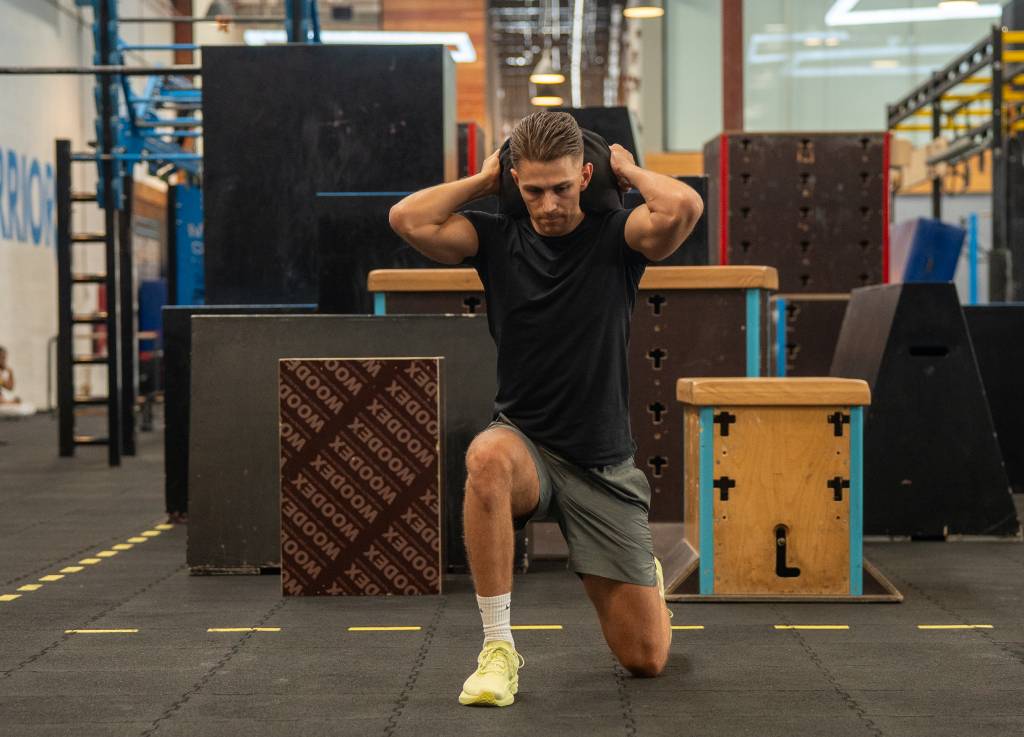
The sandbag lunge station challenges your legs after cumulative fatigue from previous stations. You must complete 100 meters of walking lunges while carrying a sandbag on your shoulders. Open category athletes use 20kg for men and 10kg for women, while Pro athletes increase to 30kg and 20kg.
The sandbag can be held in a bear hug or draped across the shoulders. Each lunge requires proper depth, with the back knee touching or nearly touching the ground. At roughly 50 or more lunges per leg, this station tests lower-body muscular endurance.
Muscles Targeted
- Quadriceps: Handle the main load during the lowering and standing phases.
- Glutes: Drive hip extension and power the upward phase.
- Hamstrings: Control descent eccentrically and assist glutes.
- Core: Stabilizes the sandbag and prevents torso collapse.
- Shoulders: Support the sandbag in a bear hug or shoulder carry.
The Movement
- Secure a sandbag on your shoulders.
- Step forward into a lunge position.
- Lower back knee toward the ground.
- Drive through the front heel to stand.
- Step directly into the next lunge.
- Keep the torso upright throughout.
The Challenge
By Station 7, legs are fatigued from sled pushes, burpee broad jumps, rowing, and running. Quadriceps burn intensely, and the sandbag may shift, requiring constant adjustment. Completing 100 meters without prior leg training exposes weaknesses and makes proper pacing essential.
Strategy
- Find a stable sandbag position.
- Focus on consistent step length.
- Drive through the heel, not the toe.
- Break distance into mental chunks (4 x 25m).
- Breathe on every step and avoid rushing.
- Train lunges regularly to build endurance.
Weekly Training Protocol
- Weighted walking lunges: 4 x 50m with 20kg+.
- Bulgarian split squats: 3 x 12 each leg.
- Goblet lunges: 3 x 20 reps.
- Lunge + run combos: 50m lunges + 400m run x 4 rounds.
Coach Insight: Your legs will want to quit here. This is where all those functional leg sessions pay off. We program lunges into almost every workout at Gravity because they’re foundational to real-world strength and HYROX success. If you skip leg day, Station 7 will expose you.
STATION 8: Wall Balls (100 reps)

The wall balls station is the final test before your last 1km run. You must complete 100 full repetitions, throwing a medicine ball at a wall target. Men throw a 6kg ball to a 3-meter target, women use a 4kg ball to a 2.7-meter target, while Pro athletes use 9kg and 6kg balls.
Each rep requires a full squat with the hip crease below the knee, and the ball must hit the target line. Missed reps waste energy without progress.
Muscles Targeted
- Quadriceps: Power the squat and absorb landing impact.
- Glutes: Drive hip extension to generate upward momentum.
- Shoulders: Guide the ball and absorb the catch.
- Arms and triceps: Provide the final push to reach the target.
- Core: Transfers power from legs to upper body.
The Movement
- Hold the ball at chest height.
- Squat to proper depth.
- Drive up explosively through your legs.
- Use leg power to throw the ball.
- Catch on descent.
- Immediately descend into the next squat.
The Challenge
After seven stations and 7km of running, full-body exhaustion makes 100 reps daunting. Fatigue can reduce coordination and lead to sloppy technique, increasing time and energy cost. With another 1km run after this, emptying your tank here can backfire.
Strategy
- Break into manageable sets: 25/25/25/25 or 20/20/20/20/20.
- Drive with legs, not arms.
- Catch and redirect in a smooth motion.
- Trust your depth, don’t stare at the target.
- Count out loud or in groups of 10.
- Finish strong but preserve energy for the run.
- Practice wall balls fatigued in training.
Weekly Training Protocol
- Wall ball sets: 5 x 25 reps, 60-second rest.
- Thrusters: 4 x 15 reps.
- Air squat endurance: 100 unbroken reps.
- Combo finisher: 50 wall balls + 400m run x 2.
Commit to the Coolest Version of Yourself.
Putting It All Together: Sample 8 Week HYROX Training Plan
This 8-week HYROX training plan provides a structured framework to prepare for race day, focusing on endurance, strength, and station-specific skills.
Phase 1: Base Building, Weeks 1 to 3
During this phase, you focus on building cardiovascular endurance through steady-state runs and low-intensity station work, allowing your body to adapt without burnout. You refine your technique for all eight HYROX stations, prioritizing form over speed or load.
Running development progresses toward a comfortable 8km at an easy conversational pace to establish an endurance foundation. Incorporate strength training three times per week, focusing on compound movements such as squats, deadlifts, rows, and presses.
Phase 2: Intensity Building, Weeks 4 to 6
Station training intensity should be increased by adding heavier loads, faster paces, and higher repetitions to push beyond your comfort zone. Use race simulation workouts that combine multiple HYROX stations and runs to replicate the cumulative fatigue you will experience during competition.
Running intervals, including 400m and 800m repeats, will help you build speed endurance and train your body to recover while moving. Combo sessions practice back-to-back station work without full recovery, preparing both body and mind to perform under fatigue.
Phase 3: Race Simulation, Week 7
Week seven should include a full or near full race simulation. You can perform all eight HYROX stations with scaled loads if needed. The session should test your pacing, transitions, and weak points. This is also the best time to refine target split times.
Also, focus on your transition practice. Learn how to enter each zone, start work, finish cleanly, and return to running without wasted steps. Refine your pacing strategies based on simulation performance. Includes visualization techniques for mental preparation.
Phase 4: Taper, Week 8
At this HYROX training stage, reduce your training volume by 40-50% and focus on recovery and energy storage. You should maintain intensity in key sessions but with fewer sets and repetitions. Recovery is prioritized through 7-8 hours of sleep, proper nutrition, and hydration.
Engage in light movement and mobility, including easy runs, stretching, foam rolling, and mobility exercises. Keep your body loose without adding fatigue. Following this HYROX training plan helps you build endurance, strength, and technique, preparing you to perform efficiently across all stations on race day.
Still Thinking About It? Just Book It.
Book a ClassYour HYROX Journey Starts with Station Mastery
Mastering each HYROX station is what separates finishers from competitors. Every repetition, meter, and transition contributes to your overall performance, and focusing on station-specific training will give you the edge on race day.
Whether this is your first HYROX race or you’re returning to improve your personal best, consistency in your training is more valuable than short bursts of intensity. Progress comes from regular practice and developing endurance, strength, and technique across all HYROX stations.
Joining the Gravity Calisthenics Gym community gives you access to expert guidance, structured sessions, and support from athletes who share the same goals. Remember, every HYROX athlete started exactly where you are now. Your journey begins with commitment, station by station, step by step, and with consistent practice, you will be ready to compete at your best.
Book a free trial class now to get started!